
Hydraulic Pumps: How to Choose the Most Suitable Technology for Each Application
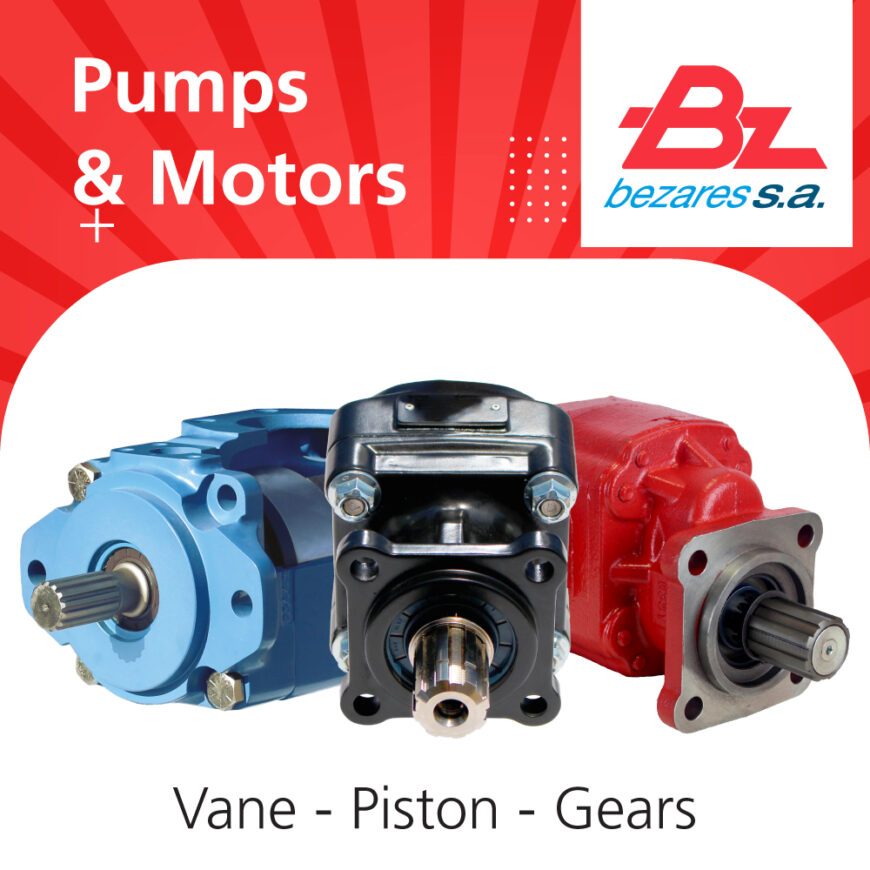
In mobile and industrial hydraulics, selecting the right pump is a key factor in ensuring the performance, efficiency, and reliability of any system. Among the most widely used technologies are gear, piston, and vane pumps, each with distinct characteristics that make them particularly suitable depending on the application, working conditions, and requirements related to pressure, flow, or control.
Gear pumps remain one of the most widely used solutions, especially in mobile applications and in systems where robustness, simplicity, and cost-effectiveness are priorities. Their compact and straightforward design, with a reduced number of moving components, simplifies maintenance and provides high reliability. They also offer good resistance to contamination and are commonly integrated into equipment such as dump trucks, cranes, hook loaders, or refuse collection vehicles. However, their fixed displacement and lower efficiency compared to other technologies limit their use in high-pressure applications or in systems where energy optimization is critical.
Vane pumps, on the other hand, represent a very balanced alternative when the objective is to combine performance, smooth operation, and low noise levels. Their design allows them to generate a more uniform and stable flow with fewer pulsations, resulting in quieter and more comfortable operation. They also perform well within medium-pressure ranges, offer relatively simple maintenance thanks to replaceable cartridge designs, and provide strong versatility in terms of configurations and flow rates. In many cases, there is also component compatibility between manufacturers, which facilitates maintenance and spare parts availability. As a drawback, they require proper oil filtration and, although they offer excellent performance in many environments, they are generally not the first choice for continuous operation at very high pressures.
When an application demands maximum performance, high efficiency, and continuous operation at elevated pressures, piston pumps become the reference technology. Their high volumetric and mechanical efficiency, high power density, and precise control capabilities make them an ideal solution for demanding systems in both mobile and industrial environments. In addition, specific versions with variable displacement or dual flow are available, capable of adapting supply to system demand, reducing energy consumption and oil heating. However, these advantages come with greater technical complexity, higher initial cost, and increased sensitivity to contamination, meaning they require proper filtration systems and specialized personnel for maintenance or repair.
In this context, selecting one technology or another does not depend solely on pump performance, but rather on a combined analysis of variables such as working pressure, required flow, operating cycles, desired efficiency level, ease of maintenance, and overall system budget. Gear pumps provide simplicity and cost efficiency; vane pumps offer balance and smooth operation; and piston pumps deliver maximum performance under demanding conditions.
At Bezares, we offer a wide range of solutions to meet these needs, including gear and vane technologies, as well as our FR range of piston pumps, with dual-flow (FR2) and variable-flow (FRV) versions designed to deliver optimal performance in demanding applications.
Ultimately, there is no single solution suitable for every case. The key lies in selecting the technology that best fits each application, ensuring a more efficient, reliable, and durable hydraulic system.